The Platform · QPCI

Engineering a new generation of health-measurement instruments.

QPCI is a developing measurement architecture for distributed physiological response. Fieldflux engineers the sensing, calibration, time synchronization, and evidentiary controls needed to investigate health-relevant patterns at increasing depths of physical measurement.

Phase-coherence imaging

A controlled perturbation, a witnessed response.

The method is simple to state. Apply a controlled perturbation to the body — a stimulus that is characterized and witnessed the instant it is delivered — and record the response simultaneously at many distributed sites, every channel resolved against one shared timebase.

What carries the information is timing, not amplitude. From each site we recover a complex response — how much, and how far ahead or behind — and from the pairings between sites, left against right and level against level, we reconstruct the phase-coherence topology: a calibrated map of how a distributed living system stays coordinated with itself. The perturbation is the point — by comparing the coordination the body holds under drive against its own baseline, the reading measures how that organization deforms, often before any single level looks abnormal. Because the stimulus, the clock, and every response are witnessed and sealed, the whole measurement replays from the raw record.
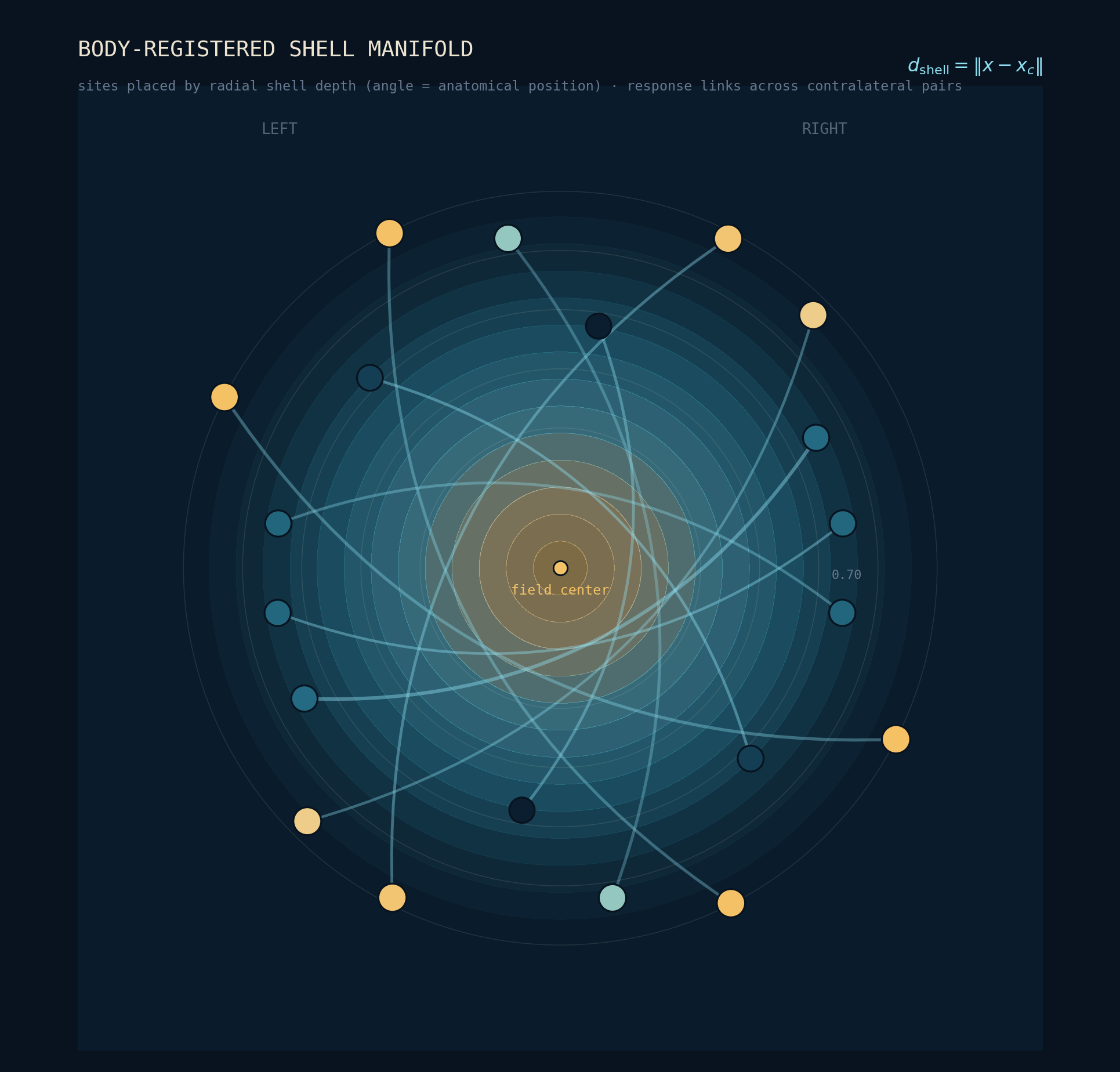
Body-registered shell manifold: measurement sites embedded by radial shell depth, with response vectors between contralateral pairs.

The architecture

Eleven layers, one sealed packet.

The same pipeline runs on every instrument — from the witnessed drive stimulus to a sealed, witness-qualified packet that carries its own provenance. Change the hardware and the signal quality changes with it; the mathematics and the packet format do not.

01Drivetimed stimulus
02Capturemulti-site response
03Phaseharmonic response
04Topologycross-site coherence
05Fieldcalibrated reconstruction
06Packetsealed & witnessed

A high-level view. The full eleven-layer specification is documented in the technical brief, available to qualified partners on request.

The instruments

From phone to laboratory.

One engineering program with several instrument stages: mobile research, portable source-witnessed hardware, and a future multimodal array. Each stage has its own calibration and validation needs.

01 · DRTT

On your phone, today

Distributed Real-Time Topology turns your ordinary iPhone into a research-grade instrument — the torch delivers the controlled stimulus, the camera records the multi-site response. No accessory required.

Shipping

02 · Rev B BWI

The research portable

A battery-isolated Boundary Witness Instrument that adds a directly witnessed source — closing the measurement to real physical units across multiple body nodes.

Prototype · late 2026

03 · QPCI

Hospital-grade

A hospital-grade, multimodal array — quantum diamond magnetometry, electrical impedance tomography, EEG and optical redox — fused on one master clock.

In development

Membrane Health is available as a consumer software application. DRTT and the source-witnessed instrument program are developing research technologies that require their own calibration and validation. The shared measurement architecture is designed to preserve provenance while distinguishing the evidence each instrument can support.

Go deeper, under NDA.

The full architecture — adjudication predicates, closure classifications, packet schemas, and hardware specifications — is available to qualified partners, clinicians, and investors. Request the technical brief.

Request the brief

Contact

Developing instruments. Deeper evidence.